Inflation Data Shows Progress But is Overshadowed By the Iran Conflict
Last week's economic data provided encouraging signs that inflation is continuing to moderate, but global economic tensions are creating uncertainty for financial markets and mortgage rates.


Iran Conflict Drives Volatility in Mortgage Rates
The biggest wildcard for mortgage rates right now is the escalating conflict involving Iran. The war has disturbed global energy markets and pushed oil prices sharply higher, with crude rising toward $100 per barrel as supply risks increase across the Middle East. Higher oil prices tend to push inflation expectations higher, which is problematic for the bond market. When inflation expectations increase, investors typically sell bonds which causes bond yields (and by extension, mortgage rates) to rise.
This dynamic has been seen in recent weeks. Just as mortgage rates had reached some of their lowest levels in nearly three years, the geopolitical shock from the Iran conflict introduced new (and unexpected) volatility into the bond market which began pushing bond yields higher. In response, the average 30-year fixed rate rose to its highest level this year.
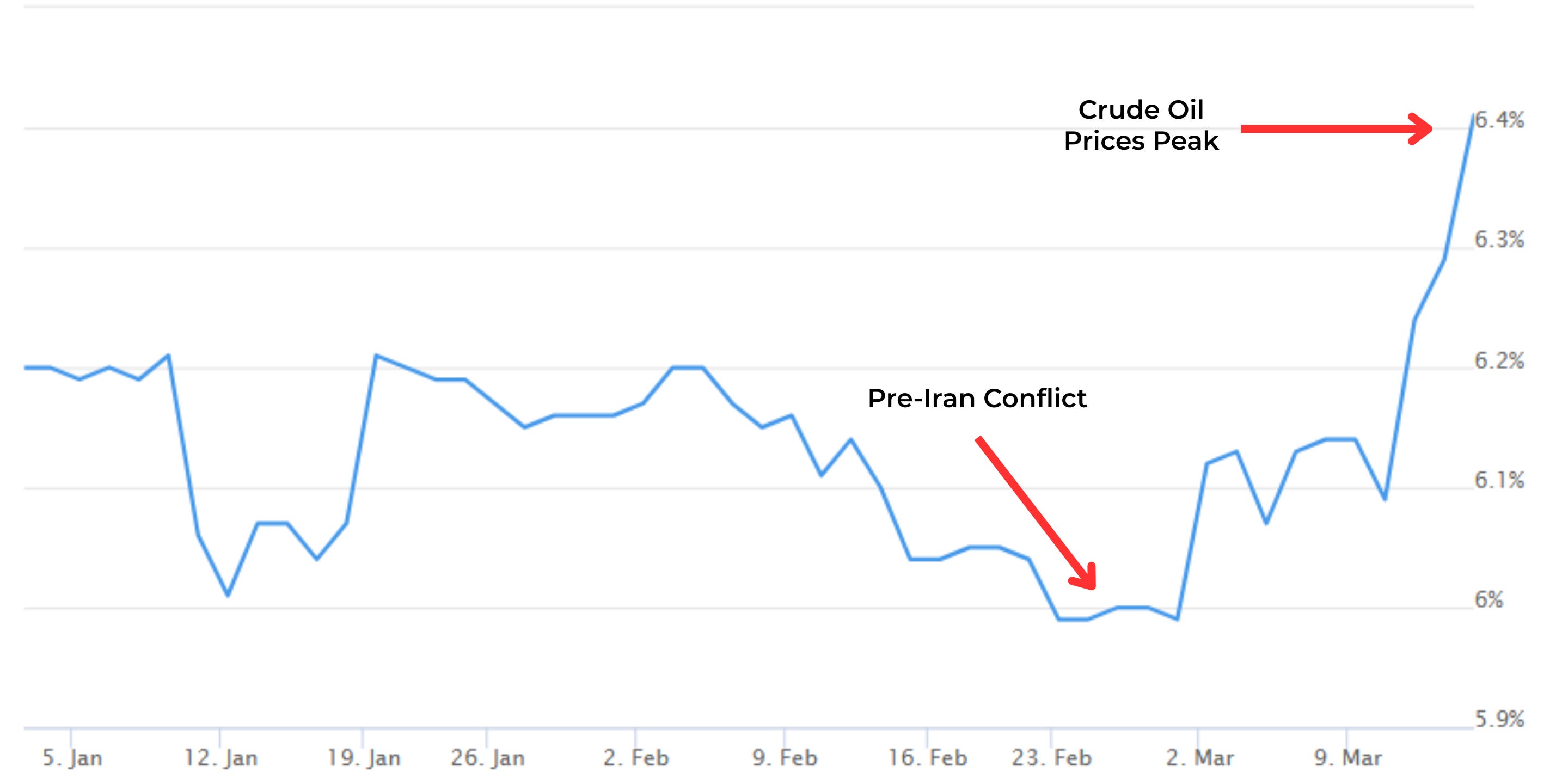
At the same time, financial markets remain highly sensitive to headlines surrounding the conflict. Early last week, mortgage-backed securities rallied briefly after comments from President Donald Trump suggested the war could end soon, demonstrating how quickly geopolitical developments can shift interest rates.
Bottom Line? Inflation data continues to show gradual improvement, which is a positive sign for interest rates in the long-term. However, the current environment illustrates how global events can temporarily outweigh what would otherwise be positive economic data. If energy prices stabilize and the conflict de-escalates, the improving inflation trend could allow mortgage rates to resume moving lower. But, if oil prices continue rising and inflation expectations move higher, mortgage rates may also move higher.
For now, markets are balancing two competing forces, those being cooling inflation data and rising geopolitical risks, a combination that is likely to keep mortgage rates moving in a narrow but unpredictable range.
Consumer Price Index Shows Inflation Continuing to Moderate
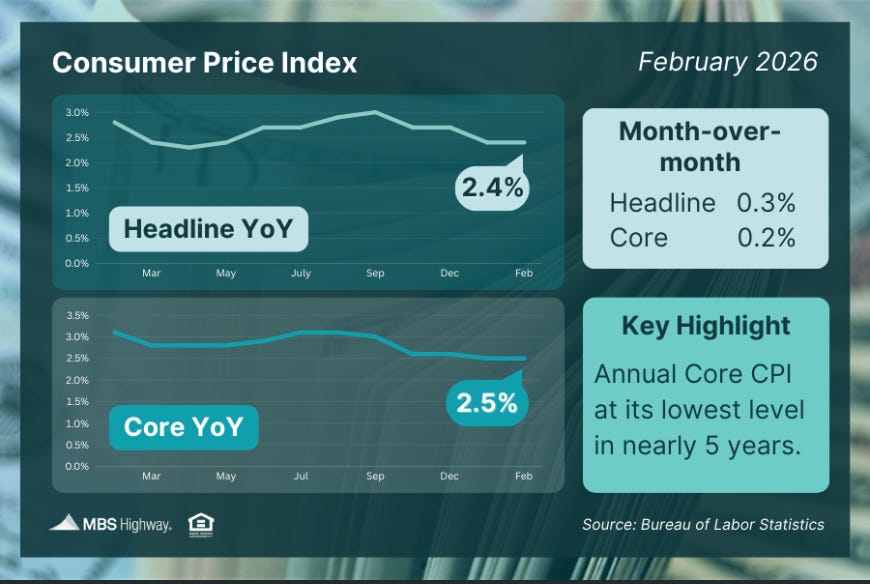
The February Consumer Price Index (CPI) Report showed inflation continuing to cool. Headline inflation rose 0.3% for the month while the year-over-year reading held steady at 2.4%, both of which were in line with expectations. Core CPI, which strips out volatile food and energy prices, increased 0.2% in February and remained at 2.5% year-over-year.
One of the most encouraging components was shelter inflation, which has been one of the most sticky components in recent years. Rent increased just 0.1% in February, which is the smallest monthly increase in five years, and Owners’ Equivalent Rent rose 0.2%.
Overall, the CPI report confirmed that inflation was still cooling headed into March. However, financial markets largely looked past this data since it reflects conditions before the recent spike in oil prices triggered by the conflict in the Middle East. It’s likely that the March and April CPI reports come back higher and we see inflation tick up in the short-term.
Personal Consumption Expenditures Sends Mixed Signals
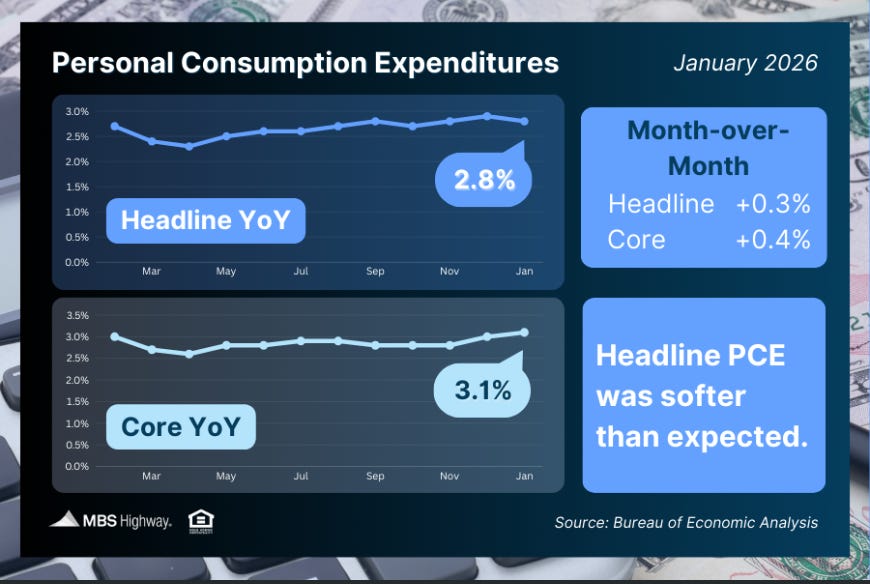
The Personal Consumption Expenditures (PCE) Index, which is the Federal Reserve’s preferred gauge of inflation, told a slightly different story. Headline PCE rose 0.3% in January, bringing the annual rate down from 2.9% to 2.8%. However, Core PCE rose 0.4% for the month and increased from 3.0% to 3.1% year-over-year, which may indicate that underlying inflation pressures remain somewhat persistent. Healthcare costs and shelter were two of the primary contributors to the monthly increase.
While the data was generally in line with expectations, financial markets largely dismissed it as “old data” since it measures January’s inflation and was released after the February CPI report. Investors are now much more focused on how inflation could evolve in the coming months, especially as energy prices surge.